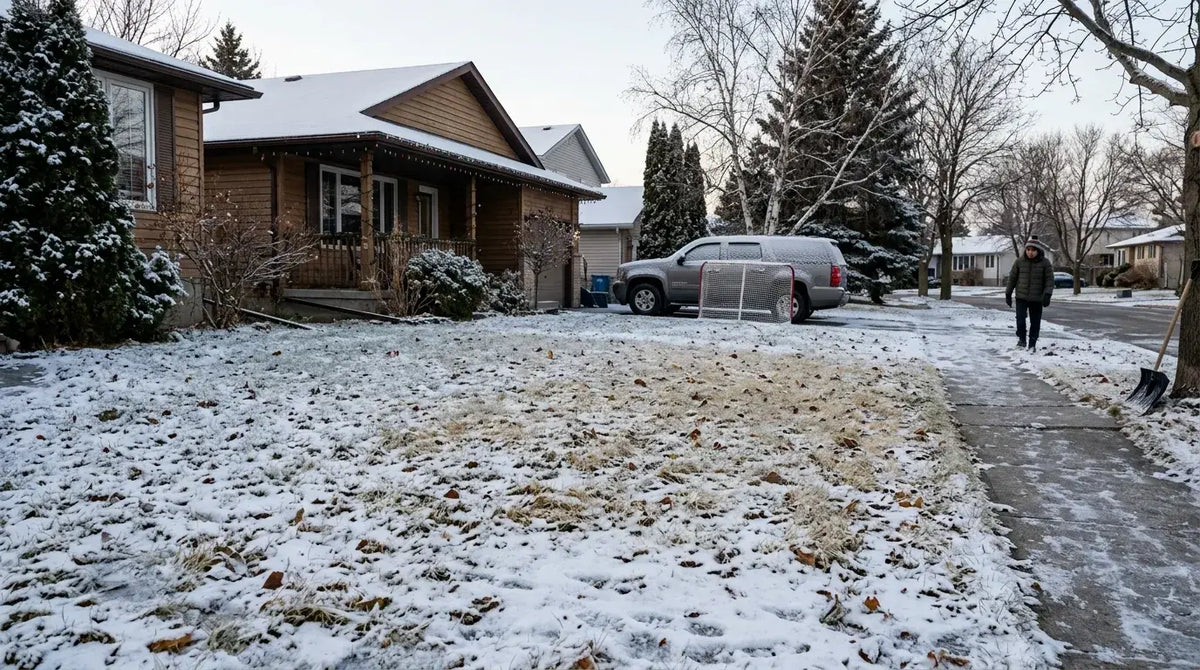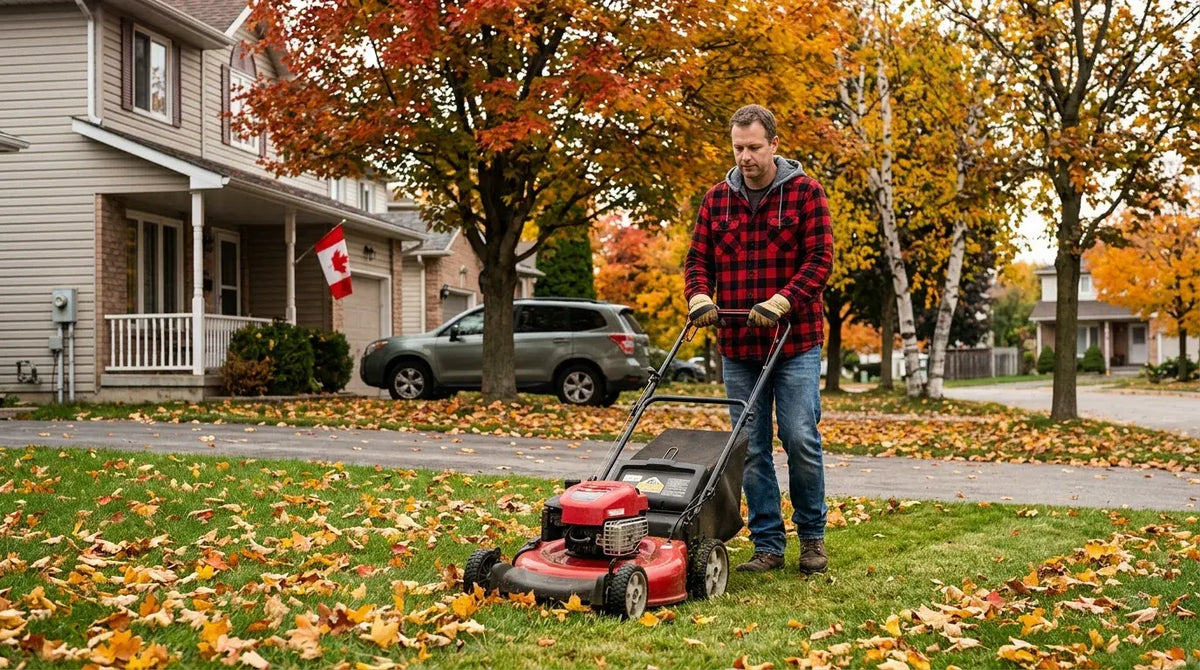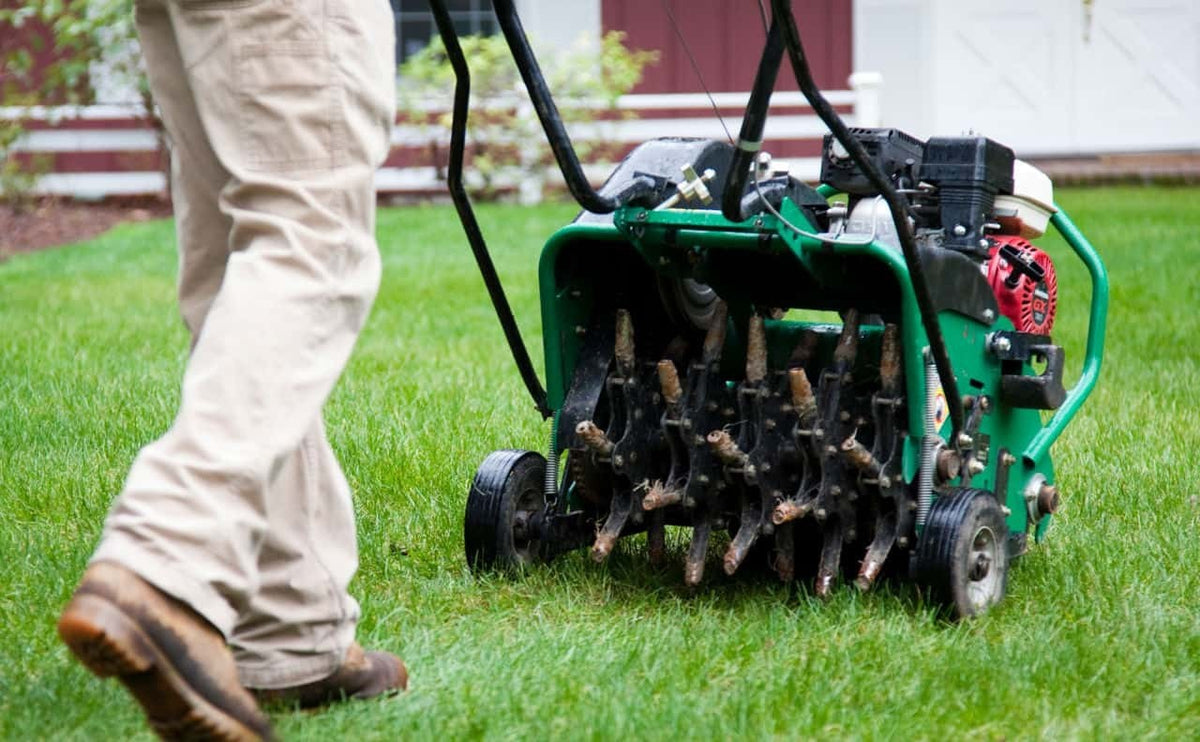





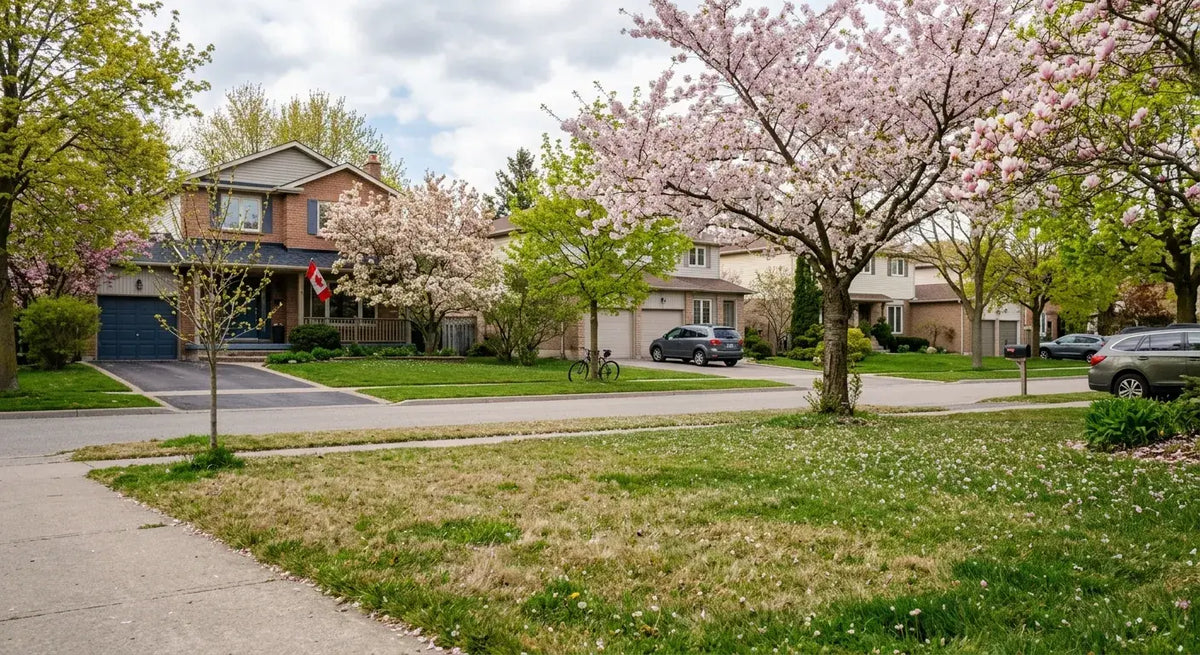
Spring lawn care in Canada is not about starting every lawn task as soon as the snow melts. Your lawn first needs time to thaw, dry, and return to active growth before you begin mowing, aerating, fertilizing, or repairing winter damage.
Cool-season Turfgrass can recover well in spring, but brown grass does not always mean the lawn is dead. Snow Mold, De-Icing Salt, Ice Cover, Soil Compaction, standing water, and winter traffic can all leave different patterns of damage, and each requires a different response.
The most effective approach is to assess before you treat. Check the condition of the Soil and Turfgrass, clean up winter debris, identify actual problems, and then apply only the treatments your lawn needs. This guide walks through that process—from the first signs of Spring Green-Up to regular summer maintenance.
Spring Lawn Care Checklist: What Should You Do in Spring?
Use this checklist as a quick starting point, but treat each step as condition-based rather than mandatory:
- ☐ Check that the Soil has thawed and is firm enough to support normal lawn maintenance.
- ☐ Inspect Turfgrass for Snow Mold, salt damage, Ice Cover damage, Bare Patches, and Soil Compaction.
- ☐ Remove leaves, twigs, gravel, and other winter debris without aggressively disturbing the turf.
- ☐ Lightly rake matted areas only after the soil is no longer soggy.
- ☐ Wait for active Turfgrass growth before making the first spring mow.
- ☐ Make the first mow when grass reaches about 3.5–4 in (9–10 cm), then maintain approximately 6–8 cm (2.5–3 in).
- ☐ Decide whether aeration, fertilization, overseeding, or other treatments are actually needed.
- ☐ Repair confirmed problems such as salt damage, Bare Patches, standing water, or drainage issues.
- ☐ Begin watering when the lawn needs moisture rather than following a fixed spring schedule.
- ☐ As temperatures rise, transition to consistent mowing, need-based watering, and regular lawn monitoring.
When Should You Start Spring Lawn Care in Canada?
The best time to start lawn care in spring is when the lawn has thawed, the Soil is firm enough to support foot traffic without deep footprints, and the Turfgrass is beginning active growth—not simply when the snow has disappeared. Most Canadian lawns contain cool-season grasses, which naturally grow most actively during the cooler conditions of spring and fall.
Use Lawn and Weather Conditions, Not a Fixed Calendar Date
Instead of starting spring lawn care on a specific date, check these three conditions first:
| What to Check | What You Want to See | What It Means for Spring Lawn Care |
|---|---|---|
| Soil condition | Soil has thawed and is firm enough to walk on without deep footprints or ruts | You can begin light cleanup and other necessary maintenance; delay intensive work if the ground is still soggy |
| Turfgrass growth | Grass is beginning to green up and grow rather than remaining uniformly dormant | The lawn is transitioning into active growth, making regular maintenance more appropriate |
| Local spring conditions | Snow has melted, temperatures are supporting growth, and moisture conditions are manageable | Your start date may be earlier or later depending on where you live in Canada |
This approach is more reliable than choosing a universal March, April, or May start date because Canadian spring conditions vary substantially by region.
Do not treat snowmelt as an automatic signal to rake, mow, aerate, or fertilize. If the Soil is still wet and easily compacted, waiting can prevent damage to the Root Zone; 2026 University of Minnesota Extension guidance likewise recommends waiting until soil is no longer soggy before working on the lawn.
For the first mowing specifically, wait until the grass is actively growing, the ground is firm, and the Turfgrass has reached roughly 3.5–4 inches (9–10 cm). This is a mowing trigger, not a universal temperature or start date for every spring lawn treatment.
How Should You Assess Your Lawn After Winter?
After snow melts, assess your spring lawn before applying fertilizer, seed, pesticides, or other treatments, because brown or damaged Turfgrass can have several different causes. Look for the pattern, location, texture, and recovery of the grass first; Canada.ca also recommends correctly identifying a lawn problem before deciding whether treatment is necessary.
Use These Signs to Diagnose Winter Lawn Damage
| What You See After Winter | Likely Cause | What to Check | What to Do First |
|---|---|---|---|
| Uniform brown grass across much of the lawn | Dormancy or delayed spring green-up | Are the crowns and new shoots beginning to green as temperatures and soil conditions improve? | Wait and monitor before assuming the grass is dead |
| Round tan, gray, or pink matted patches | Snow Mold | Pink Snow Mold commonly forms 2–8 in (5–20 cm) patches; Gray Snow Mold can form 1 in–3 ft (2.5–91 cm) patches | Lightly rake once the Soil is no longer soggy and allow the area to dry |
| Tan or brown strips beside roads, driveways, or sidewalks | De-Icing Salt injury | Does the damage follow paved surfaces or areas receiving salty runoff? | Reduce further salt exposure and allow the lawn to recover |
| Irregular brown areas where snowmelt collects | Ice Cover / poor drainage | Look for low spots, blocked drainage, standing water, or repeated freeze-thaw conditions | Improve drainage and allow saturated areas to dry before heavy lawn work |
| Flattened or damaged areas where people or equipment crossed wet turf | Soil Compaction / traffic damage | Check for footprints, ruts, or persistently wet soil | Keep traffic off the area until the Root Zone firms up |
| Small bare patches after winter | Winter injury, snow-related damage, salt, traffic, or other localized stress | Compare the damaged area with surrounding Turfgrass and identify the pattern | Wait for spring recovery before deciding whether reseeding is necessary |
Snow Mold deserves particular attention because it can look more severe than it actually is. Pink Snow Mold commonly appears as tan-to-gray matted patches about 2–8 inches (5–20 cm) wide, while Gray Snow Mold can produce patches from about 1 inch to 3 feet (2.5–91 cm); both are associated with wet, near-freezing conditions in early spring.
Salt and ice damage have different patterns that can help distinguish them from disease. De-Icing Salt injury is often concentrated beside paved surfaces, while Ice Cover damage can occur where snowmelt cannot drain or where repeated freeze-thaw conditions stress the turf. Find out what lawn care tasks you should do in the winter, see our guide "Winter Lawn Care in Canada".
When Should You Wait Instead of Repairing?
Wait when the lawn is still dormant, the Soil is saturated, or the cause of the damage is unclear. Spring is primarily a recovery season, and the 2026 University of Minnesota Extension guidance recommends gentle cleanup and patience rather than aggressive raking, early aeration, or trying to correct every visible problem immediately.
The practical rule is simple: diagnose the pattern first, confirm that the lawn has started recovering, then choose the treatment. Brown areas do not automatically mean the grass needs fertilizer, fungicide, aeration, or overseeding.
How Should You Clean Up Your Lawn After Winter?
Spring lawn cleanup should remove leaves, twigs, gravel, and winter debris while disturbing the Turfgrass as little as possible. Start only when the Soil is firm enough to work on, then use light raking to lift matted grass and debris; avoid aggressive raking or dethatching simply because the lawn looks messy after snowmelt.
What Should You Do During Spring Lawn Cleanup?
| Spring Cleanup Task | When It Makes Sense | How to Approach It |
|---|---|---|
| Remove leaves and debris | Leaves, twigs, gravel, litter, or other winter debris are covering the lawn | Remove them once the ground is firm enough to avoid creating ruts or compaction |
| Lightly rake matted grass | Grass is flattened after snow cover or Snow Mold is visible | Rake gently to improve airflow and expose the Turfgrass; stop if the soil or grass is still soft |
| Check the thatch layer | The lawn has a visible layer of dead organic material above the Soil | Measure the layer before deciding whether dethatching is necessary |
| Remove excessive thatch | Thatch is confirmed to be more than about 1 cm (½ inch) thick | Treat it as a specific corrective task, not a standard spring-cleanup step |
A healthy lawn does not need mechanical dethatching simply because dead-looking material is visible after winter. Canada.ca considers thatch thicker than about 1 cm (½ inch) excessive.
Should You Rake Your Lawn in Spring?
Yes, but spring raking should generally be light and targeted, especially after a wet winter. Once the Soil is no longer soggy, gentle raking can remove leaves, debris, and matted grass and can help improve airflow around affected Turfgrass; aggressive raking can instead damage soft turf and wet soil.
This is particularly useful where Snow Mold has left matted patches, but raking should not become an attempt to “wake up” every brown area. If the grass is still dormant or the ground remains saturated, waiting is safer than repeatedly disturbing the lawn.
Do You Need to Dethatch in Spring?
Most lawns do not need automatic spring dethatching. Dethatching is justified when a measurable excess-thatch layer is restricting water, air, and nutrient movement into the Root Zone. Canada.ca identifies thatch thicker than about 1 cm (½ inch) as excessive.
Aeration is a separate treatment: Canada.ca identifies late summer as the preferred timing for aerating compacted lawns. Therefore, do not combine spring cleanup, dethatching, and aeration into one automatic treatment schedule.
For most Canadian homeowners, the spring priority is remove debris, lightly rake where needed, assess the lawn, and let active growth resume before considering more disruptive work.
When Should You Make the First Spring Mow?
The first spring mow should happen when the Turfgrass is actively growing, the grass has reached the appropriate height, and the ground is firm enough to support the mower without leaving ruts. For many cool-season lawns, a practical first-mow trigger is about 3.5–4 inches (9–10 cm) of grass height, while Canada.ca recommends maintaining established lawns around 6–8 cm (2.5–3 inches) during the growing season.
Use These Conditions to Decide When to First Spring Mow
| First-Mow Check | What to Look For | What to Do |
|---|---|---|
| Grass height | Turfgrass has reached about 3.5–4 in (9–10 cm) | Make the first cut rather than waiting for the lawn to become excessively tall |
| Active growth | Grass is visibly greening and producing new growth | Mow only once the lawn has resumed active growth |
| Ground condition | Soil is firm and the mower will not leave deep tracks | Delay mowing if the ground is soft, saturated, or easily rutted |
| Grass condition | Grass blades are reasonably dry | Choose a dry period so the mower can cut cleanly and avoid clumping |
| Mower condition | Blade is sharp and cutting height is correctly adjusted | Sharpen the blade before the first mow and avoid scalping the lawn |
The 3.5–4 inch (9–10 cm) benchmark is specifically useful for deciding when to make the first cut; it does not mean every Canadian lawn should be cut immediately to that same height. Once regular mowing begins, Canada.ca recommends a general lawn height of 6–8 cm (2.5–3 inches).

What Height Should You Cut Grass in Spring?
For many established Canadian lawns, a mowing height around 6–8 cm (2.5–3 inches) is a useful general target rather than cutting the grass very short to “clean up” winter growth. Taller mowing can support a deeper root system and better moisture retention, while cutting too short can increase stress.
Follow the one-third rule when possible: remove no more than about one-third of the leaf tissue in a single mowing. If the lawn has grown well beyond your target height, raise the mower or make an earlier cut rather than removing a large portion of the leaf at once.
Should You Mow Wet Grass in Spring?
Avoid mowing when spring grass or the underlying Soil is wet enough to cause clumping, slipping, rutting, or soil compaction. A damp morning does not automatically make mowing impossible, but if the mower sinks into the lawn or leaves visible tracks, conditions are too wet and it is better to wait.
It recommends mowing when grass is dry and keeping the mower blade sharp so Turfgrass receives a clean cut rather than being torn.
The first spring mow should therefore be treated as a condition trigger, not a calendar event: wait for active growth, roughly 3.5–4 inches (9–10 cm) of grass, and firm ground, then begin regular mowing at an appropriate 6–8 cm (2.5–3 inch) height.
Which Spring Lawn Treatments Does Your Lawn Actually Need?
Not every lawn needs every spring lawn care treatment after winter, so choose aeration, fertilizer, overseeding, or watering based on a specific lawn problem rather than following a fixed spring checklist. In Canada, healthy Turfgrass often needs time to recover naturally, while compacted Soil, persistent bare patches, nutrient deficiencies, or dry conditions may justify targeted action.
Match the Treatment to the Lawn Problem in Spring
| Spring Treatment | When Your Lawn May Need It | When to Wait or Skip It | Practical Guidance |
|---|---|---|---|
| Aeration | Soil is genuinely compacted, water penetrates poorly, or the lawn receives significant traffic | The Soil is still wet, soft, or there is no clear compaction problem | Do not aerate simply because spring has arrived; Canada.ca generally recommends aeration in late summer for compacted lawns |
| Fertilizer | A soil test or clear nutrient-management plan indicates nutrients are needed | The lawn is still dormant, stressed, or you are applying fertilizer only because it looks brown | Use the product label and site conditions; Canada.ca notes that spring/early-summer fertilizer rates are generally lower than fall rates |
| Overseeding | Small thin or bare areas need repair and conditions are suitable for seed establishment | Large-scale renovation is needed or the lawn is still too cold, wet, or dormant | Spring overseeding is possible for some repairs, but late summer to early fall is generally the preferred timing for overseeding in Canada |
| Watering | Soil is drying and the lawn actually shows a need for moisture | Spring rainfall is keeping the Root Zone adequately moist | Water deeply rather than frequently; Canada.ca gives about 2.5 cm (1 inch) as a general deep-watering amount when irrigation is needed |
Should You Aerate Your Lawn in Spring?
Spring aeration should be reserved for lawns with a clear Soil Compaction problem rather than treated as a routine spring task. Canada.ca identifies hard, compacted ground and poor water penetration as signs that aeration may be needed, while its general guidance identifies late summer as the preferred timing for compacted lawns.
If your lawn is still wet after snowmelt, early aeration can disturb the Root Zone and contribute to compaction. Assess the problem first and postpone major aeration until the Turfgrass and Soil are in a more suitable condition.
For more info about lawn aeration, see our guide "Lawn Aeration: When, Why and How to Aerate Your Lawn in Canada".
Should You Fertilize Your Lawn in Early Spring?
Do not fertilize a lawn simply because spring has arrived or because winter has left it brown. Fertilizer decisions should consider Turfgrass growth, soil nutrients, grass type, site conditions, and the product label; Canada.ca notes that spring and early-summer fertilizer rates are generally lower than those used in early and late fall.
Early heavy fertilization can promote leaf growth before the lawn is ready to use nutrients efficiently and may increase disease risk or reduce drought tolerance. The 2026 University of Minnesota Extension guidance also recommends avoiding heavy early-spring fertilizer applications.
A soil test can provide more useful information than applying a generic fertilizer treatment, particularly when the lawn has a recurring nutrient problem.
Should You Overseed Your Lawn in Spring?
Spring overseeding can make sense for limited thin or Bare Patches, but it is not automatically the best season for major lawn renovation. Canada.ca identifies late summer to early fall as the preferred period for overseeding, so spring is better treated as an option for localized repairs when conditions are suitable.
If you are also planning spring weed control, check the specific product label before seeding. Some products have restrictions around newly seeded or overseeded lawns, so treatment timing should be coordinated rather than handled as separate checklist items.
When Should You Start Watering Your Lawn in Spring?
Start regular spring irrigation only when rainfall is no longer keeping the Root Zone adequately moist and the Turfgrass shows a genuine need for water. Canada.ca recommends watering deeply and infrequently, with about 2.5 cm (1 inch) as a general amount when irrigation is needed.
Adjust watering for Soil type, slope, rainfall, and drainage. Compacted or sloped areas may need lighter, more frequent applications, while consistently wet soil does not need additional irrigation.
How Can You Repair Common Spring Lawn Problems?
Repair common spring lawn problems by identifying the cause first, then choosing a targeted treatment instead of automatically reseeding, fertilizing, or applying pesticides. Salt damage, bare patches, standing water, and weeds require different solutions, so inspect the pattern and condition of the Turfgrass before taking action.
| Spring Lawn Problem | What to Look For | First Repair Step |
|---|---|---|
| Salt damage | Brown or tan strips beside roads, driveways, or sidewalks | Remove salty debris and prevent further salt exposure; allow rainfall to leach salts where drainage is adequate |
| Bare patches | Localized areas with little or no Turfgrass | Identify whether the cause is salt, Snow Mold, traffic, or winter injury before reseeding |
| Standing water | Water remains after snowmelt or rainfall, especially in low areas | Address drainage, grading, or compaction rather than repeatedly treating the grass |
| Spring weeds | Weeds emerging in thin or stressed Turfgrass | Identify the weed first and follow the selected product's Canadian label |
How Do You Repair Salt-Damaged Grass?
Repair salt-damaged grass by stopping continued salt exposure and allowing the Root Zone to recover before replacing dead Turfgrass. Salt injury commonly appears near paved surfaces, where road salt or salty snowmelt reaches the lawn.
Remove visible salty debris and keep additional salt-containing snow away from the lawn; where drainage is adequate, rainfall can help move soluble salts through the soil. Avoid excessive irrigation when the area already has poor drainage.
How Do You Repair Bare Patches After Winter?
Repair bare patches only after identifying why the Turfgrass failed, because winter injury, salt, disease, and traffic can require different solutions. For small patches that genuinely need reseeding, spring seeding may be possible once soil conditions are suitable; 2026 guidance from University of Minnesota Extension uses about 50°F (10°C) soil temperature as a reference for small spring repairs, while major overseeding is generally better saved for late summer or early fall.
How Do You Fix Poor Drainage and Standing Water?
Fix persistent standing water by correcting the underlying drainage or grading problem rather than simply aerating, fertilizing, or reseeding the affected area. Keep traffic and heavy equipment off saturated Soil until it firms up, then determine whether the cause is a low spot, compaction, or another drainage issue.
When Should You Use Spring Weed Control?
Use spring weed control after identifying the weed and checking that the product's timing is appropriate for that species and growth stage. Some crabgrass-prevention guidance uses a 12.8°C (55°F) soil-temperature trigger, but this applies specifically to that weed-control context and should not be treated as a universal spring lawn-care temperature.
Always follow the registered Canadian product label, particularly if you also plan to overseed. Canada.ca recommends identifying the lawn problem before deciding whether pesticide treatment is necessary.
How Do You Transition From Spring Lawn Care to Summer Maintenance?
Once your lawn has recovered from winter and is growing consistently, spring lawn care should shift from cleanup and repair to a regular summer maintenance routine. Keep mowing at about 6–8 cm (2.5–3 inches), water only when the lawn needs it, and continue checking for weeds, disease, compaction, and other developing problems.
Return to a Consistent Mowing Routine
As Turfgrass enters active growth, establish a regular mowing schedule instead of waiting until the grass becomes overgrown. Keep the mowing height around 6–8 cm (2.5–3 inches) and follow the one-third rule so you do not remove too much leaf tissue at once.
Adjust Watering as Temperatures Increase
Do not continue a fixed spring watering schedule as temperatures rise. Water when the lawn shows signs of needing moisture, generally applying about 2.5 cm (1 inch) during a deep watering, while adjusting for rainfall, soil type, slopes, and drainage.
Monitor for Weeds, Disease, and Compaction
Regularly inspect the lawn as growth becomes more active, especially where spring damage, standing water, heavy traffic, or thin Turfgrass remains. Treat the underlying problem rather than automatically applying fertilizer or pesticides; Canadian guidance recommends checking the lawn regularly so problems can be identified early.
Can a Robot Lawn Mower Help With Spring Lawn Care?
A robot lawn mower can help with the repetitive mowing portion of spring and summer lawn maintenance once the ground is firm and the Turfgrass is ready for regular cutting. For example, Mammotion's LUBA 3 AWD supports adjustable mowing settings, multiple mowing zones, and AWD operation for slopes up to 80% (38.6°) on applicable models. Check all Mammotion robot lawn mowers.

However, a robot mower does not replace spring cleanup, lawn diagnosis, aeration, overseeding, fertilization, drainage correction, or weed control. Its role is best understood as an automation tool for maintaining the mowing routine after the lawn has transitioned into active growth.
Spring Lawn Care FAQ
Start spring lawn care when the lawn has thawed, the soil is firm enough to support foot traffic, and Turfgrass has begun active growth. Snow Melt alone is not a signal to immediately rake, mow, aerate, or fertilize, because Canadian spring conditions vary by region and site.
First, inspect the lawn for winter damage, standing water, Snow Mold, salt injury, and compacted or rutted areas. Remove leaves and debris gently once the surface is firm, then decide which problems actually need treatment.
Yes, but use light, targeted raking rather than aggressive power raking. Rake away leaves, twigs, and matted material after the soil has firmed, while avoiding unnecessary disturbance to wet Turfgrass.
Make the first spring mow when the grass is actively growing, the ground is firm, and the Turfgrass has reached roughly 3.5–4 inches (9–10 cm). After that first cut, maintain an established lawn around 6–8 cm (2.5–3 inches) and avoid removing more than one-third of the leaf height at once.
A practical first-mow trigger is about 3.5–4 inches (9–10 cm), provided the lawn is actively growing and the ground is firm. The ongoing mowing target for many Canadian lawns is approximately 6–8 cm (2.5–3 inches).
No, not automatically. Fertilization should depend on grass condition, soil fertility, and the lawn's actual nutrient needs; Canada.ca notes that fertilizer rates are generally lower in spring and early summer than in early and late fall.
No. Aerate when Soil Compaction is a genuine problem rather than treating spring aeration as a mandatory annual task. If the lawn drains poorly, first determine whether compaction, grading, soil type, or another drainage issue is actually responsible. Canada.ca generally recommends aerating compacted lawns, with fall identified as the preferred timing.
Spring overseeding can repair some small thin or Bare Patches, but it is not automatically the best season for major lawn renovation. For many Canadian lawns, Canada.ca identifies late summer to early fall as the preferred period for overseeding.
Water only when the lawn needs moisture rather than following a fixed calendar schedule. As a general benchmark, apply about 2.5 cm (1 inch) during a deep watering, while adjusting for rainfall, soil type, slope, drainage, and local conditions.
Once the lawn is actively growing, shift from winter recovery to consistent mowing, need-based watering, and regular monitoring for weeds, disease, compaction, and thin areas. Maintaining healthy Turfgrass through the transition can reduce later pest and drought problems.
Conclusion
Spring lawn care in Canada works best as a recovery process, not a fixed checklist. Start by checking whether the Soil has thawed and firmed, confirm that Turfgrass is entering active growth, and assess winter damage before deciding which treatments your lawn actually needs.
The practical sequence is simple: Assess ➔ Clean Up ➔ Diagnose ➔ First Mow ➔ Treat Only If Needed ➔ Repair ➔ Maintain. Not every lawn needs spring aeration, fertilization, overseeding, or weed control, and major renovation work may be better suited to late summer or early fall.
Once the lawn has recovered and active growth is established, shift your focus toward consistent mowing, need-based watering, and regular monitoring. This approach helps you address actual lawn problems without adding unnecessary work or stressing Turfgrass during the spring recovery period.
Did you like this article? Add us as a preferred source to find us more easily on Google.