




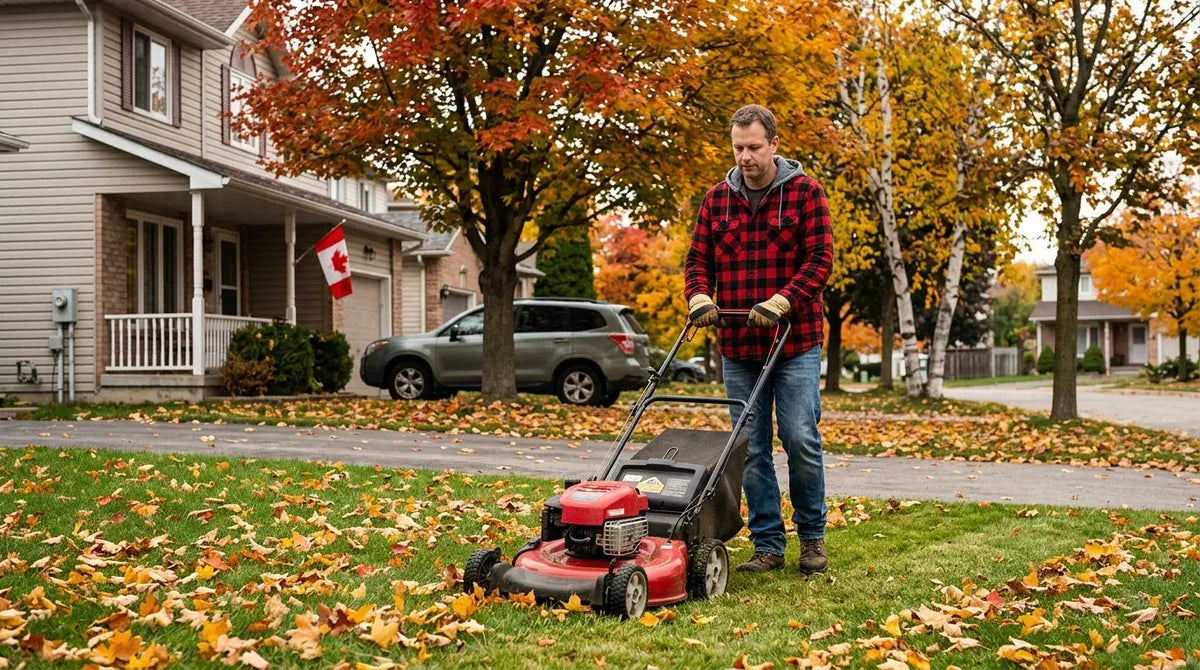
Fall lawn care in Canada is about preparing your grass for winter without doing unnecessary work. The right approach is to keep mowing while grass is actively growing, manage leaves, address compaction or thin areas when needed, and adjust watering and fertilization to soil and weather conditions. Because Canada spans multiple climate zones, there is no single fall lawn care date or checklist that fits every lawn. This guide explains what to do, when to do it, and which tasks your lawn may not need before winter.
Fall Lawn Care Checklist: What Does Your Lawn Actually Need?
A complete fall lawn care routine does not mean performing every available treatment; start by inspecting the lawn, then choose mowing, leaf management, aeration, overseeding, watering, or fertilization according to visible turf and soil conditions.
For most Canadian lawns, a practical baseline is to maintain grass around 6–8 cm (2.5–3 inches) while it is actively growing, while thatch thicker than 1 cm (0.5 inch) and compacted soil are signs that additional corrective work may be needed.
Inspect the Grass Before Starting Fall Lawn Care
Before choosing a fall lawn-care task, inspect four things: grass density, soil compaction, thatch depth, and water penetration. A lawn with dense turf and no obvious soil problems may need little more than continued mowing and leaf management, while thin turf, hard soil, or poor infiltration can justify additional work.
Check for these conditions:
- Thin or bare areas: Consider overseeding if the cause has been identified and growing conditions remain suitable.
- Hard or compacted soil: Consider core aeration where soil compaction is limiting root growth or water penetration.
- Thatch thicker than 1 cm (0.5 inch): Assess whether dethatching or another corrective treatment is appropriate.
- Poor water penetration: Investigate compaction, soil structure, slope, or drainage before simply adding more irrigation.
- Healthy, dense turf: Continue mowing and leaf management rather than automatically adding treatments.
The important distinction is that fall lawn care should be condition-based, not a fixed list of treatments that every Canadian lawn receives.
Match the Lawn Problem to the Fall Lawn Care Task
The most efficient fall lawn-care plan is condition-based: mow a healthy lawn, overseed thin areas, aerate compacted soil, manage excessive thatch, and correct watering or drainage problems instead of automatically applying every treatment.
| What you find | Fall lawn care response |
|---|---|
| Dense, healthy grass | Continue mowing and manage leaves |
| Thin or sparse turf | Consider overseeding |
| Hard or compacted soil | Consider core aeration |
| Thatch thicker than 1 cm | Assess dethatching |
| Poor water penetration | Check compaction and drainage |
| Unknown nutrient needs | Consider soil testing before fertilizing |
Soil testing is particularly useful when fertilizer requirements are uncertain because nutrient needs depend on soil and site conditions rather than a universal fall application rate.
Fall Lawn Care Priority Order
A practical fall lawn care sequence is to inspect first, maintain mowing, correct compaction when necessary, overseed suitable thin areas, maintain moisture, address nutrient needs, and manage leaves before winter. Aeration should generally come before overseeding when both are needed because opening compacted soil can improve seed-to-soil contact, while aeration itself will not solve every drainage or soil problem.
- Inspect the lawn
- Continue mowing while grass is actively growing
- Aerate if soil is compacted
- Overseed thin or damaged areas when conditions are suitable
- Maintain adequate moisture for existing turf and new seed
- Address nutrient needs based on soil, grass, site, and product instructions
- Manage leaves before they form a persistent mat
This diagnosis-first sequence prevents a common mistake: treating every lawn as though it needs aeration, overseeding, dethatching, and fertilizer every fall.
Fall Lawn Mowing: How Short Should You Cut Grass Before Winter?
For fall lawn mowing, keep cool-season turf within a moderate height range while it is actively growing, rather than cutting it progressively shorter as winter approaches. A Canadian baseline is 6–8 cm (2.5–3 inches), and mowing should continue as long as the grass is still growing, with the final cut made before growth stops rather than on a fixed calendar date.
Fall Lawn Mowing Height
For most Canadian lawns, 6–8 cm (2.5–3 inches) is a useful general mowing target, although the appropriate height can vary with grass species and local growing conditions. Cutting too short can reduce leaf area and place additional stress on the turf, while leaving grass excessively long going into winter can create other maintenance problems.
A practical height check:
- Below 6 cm: Avoid repeatedly maintaining this height unless it matches the requirements of the specific turfgrass.
- 6–8 cm: A practical Canadian baseline for many established lawns.
- Above 8 cm: Reduce height gradually rather than removing more than one-third of the blade at once.
- Wet grass: Delay mowing until the surface is suitable for mowing.
A sharp mower blade also matters. The cutting blade, rather than the Cutting Deck itself, should be kept sharp so the mower cuts grass cleanly.
The One-Third Mowing Rule
The one-third rule means removing no more than approximately one-third of the grass blade during a single mowing session. For example, if your target Cutting Height is 7.5 cm (3 inches), mow when the grass reaches roughly 11.5 cm (4.5 inches) rather than waiting until it becomes substantially taller.
This rule is especially useful in fall because growth gradually slows and mowing intervals become less predictable. Instead of following a rigid weekly schedule, check the actual grass height and mow when enough growth has occurred to make a clean cut.
| Situation | What to do |
|---|---|
| Grass is still growing normally | Continue mowing according to height |
| Grass has grown more than one-third above target | Mow rather than removing a large amount at once |
| Lawn is wet | Wait for drier conditions |
| Growth has slowed significantly | Increase the interval between mowing sessions |
| Grass has stopped growing | Stop routine mowing |
Final Mowing Before Winter
The final fall lawn mowing should occur while grass is still actively growing and before persistent winter conditions make mowing impractical, rather than on a universal Canadian date or by forcing the lawn to an unusually short height. Regional temperature, grass growth, and the expected frost period should determine the timing.
Some extension guidance for specific cool-season turf regions uses heights around 5.1 cm (2 inches) or higher for particular situations, but that should be treated as regional turf guidance rather than a Canada-wide requirement.
For Canadian homeowners, the better rule is:
Follow grass growth and local frost timing first; do not follow a single calendar date for the entire country.
Fall Lawn Aeration and Overseeding: When Should You Do Both?
For Canadian cool-season lawns, fall lawn aeration and overseeding work best when the grass is actively growing and soil conditions are suitable, with aeration used mainly to relieve compaction and improve seed-to-soil contact before overseeding. It recommends aerating compacted soil and overseeding thin areas.
Fall Lawn Aeration
Fall lawn aeration is most appropriate when soil is compacted, water penetration is poor, or repeated foot traffic has reduced soil pore space, and core aeration can be used to remove small plugs of soil and improve soil-to-air and water movement. Aerate when the soil is moist enough to penetrate but not saturated, because extremely wet soil can smear or compact rather than open cleanly.

Look for these indicators:
- Hard soil that is difficult to penetrate
- Water remaining on the surface instead of infiltrating normally
- Turf growing poorly despite adequate mowing and moisture
- Areas exposed to repeated traffic
- Thatch or soil conditions that are interfering with water and air movement
Aeration does not automatically need to occur every year. Higher-use lawns may require more frequent aeration, while lower-traffic lawns may need it less often; the actual interval should be based on compaction rather than a fixed annual schedule; University of Maryland Extension notes that heavy-use lawns may need aeration every 1–2 years, while lower-traffic home lawns may need it only every 2–4 years.
For more details about lawn aeration, see our guide "Lawn Aeration: Why, When, and How to Aerate Your Lawn?"
Fall Lawn Overseeding
Fall lawn overseeding is most useful for thin, sparse, or damaged turf when the existing grass and weather conditions still provide enough time for new seedlings to establish before winter. Canada.ca identifies late summer to early fall as a suitable overseeding period, while current extension guidance also identifies early fall as a useful window for cool-season turf renovation.
For Canadian lawns, check these conditions first:
| Lawn condition | Overseeding approach |
|---|---|
| Thin turf with suitable soil | Overseed |
| Bare patches caused by an unresolved problem | Correct the cause first |
| Compacted soil plus thin turf | Aerate, then overseed |
| Severe drainage problem | Correct drainage before relying on seed |
| New seed | Maintain consistent moisture during establishment |
Overseeding is therefore a repair tool, not a universal fall task. If shade, drainage, compaction, or unsuitable soil is causing the thinning, adding seed without addressing the underlying condition may produce limited results.
When to Aerate Before Overseeding
When fall lawn care requires both aeration and overseeding, aerate first and then seed so the newly opened soil has better contact with the seed, provided the soil is suitable for aeration and the turf is within an appropriate establishment window. Aeration should not be treated as a cure for persistent standing water or soil that remains saturated.
The basic sequence is:
If water remains on the lawn after normal rainfall or the soil stays saturated, investigate drainage before assuming aeration and seed will solve the problem.
Fall Lawn Fertilization and Watering: How Much Does Grass Need?
Fall lawn fertilization and watering should be based on the lawn’s nutrient status, soil conditions, weather and grass growth—not simply because the calendar says it is fall. As a practical Canadian baseline, established turf generally needs about 2.5 cm (1 inch) of water when irrigation is necessary, usually no more than once a week without rainfall, while fertilizer amount and frequency should follow soil and grass requirements and the product label.
Fall Lawn Fertilizer
Fall lawn fertilizer should be selected and applied according to soil nutrient status, grass type, site conditions, weather, and the fertilizer label rather than using one universal application rate for every Canadian lawn. Canada.ca recommends soil analysis periodically when nutrient requirements are uncertain, while Canadian fertilizer labeling rules provide application directions and guaranteed-analysis information that should be followed.
Before applying fertilizer, check:
- Grass type
- Soil test or nutrient information
- Guaranteed analysis on the product
- Application rate
- Coverage area
- Timing restrictions
- Provincial or municipal requirements
- Current weather and soil moisture
Avoid applying fertilizer simply because it is fall. If the soil already contains sufficient nutrients, additional fertilizer may not provide the intended benefit.
Fall Lawn Watering
Fall lawn watering should become less frequent as rainfall increases and grass growth slows, but newly overseeded areas need more consistent moisture during establishment. For established turf, Canada.ca recommends watering only when needed, generally no more than once per week without rainfall, with approximately 2.5 cm (1 inch) applied during a typical deep watering.
Use the lawn and soil to adjust that baseline:
| Condition | Watering approach |
|---|---|
| Established lawn with adequate rainfall | Additional irrigation may not be needed |
| Established lawn during dry weather | About 2.5 cm (1 inch) when needed |
| Newly overseeded area | Maintain consistent moisture during establishment |
| Compacted or poorly infiltrating soil | Investigate the cause instead of simply adding water |
| Sloped area | Shorter irrigation cycles may reduce runoff |
| Saturated or waterlogged soil | Do not add irrigation |
The goal is not to maximize watering frequency. The goal is to keep the root zone adequately supplied with moisture while avoiding unnecessary saturation.
Fall Lawn Fertilizer Numbers You Should Not Guess
The most important fertilizer number is not a universal “fall rate”; it is the application rate appropriate for your lawn, soil test and specific product.
A useful way to read the fertilizer label is:
- N-P-K: identifies the guaranteed percentages of nitrogen, phosphorus and potassium.
- Application rate: tells you how much product to apply to a defined lawn area.
- Coverage area: tells you how much lawn one package is intended to treat.
- Timing restrictions: may apply to newly seeded or overseeded turf.
- Provincial or municipal rules: may impose additional restrictions on certain fertilizer or lawn products.
For example, a fertilizer labeled 21-7-7 provides a guaranteed analysis of 21% nitrogen, 7% available phosphate expressed according to Canadian fertilizer-label conventions, and 7% soluble potash—not simply three interchangeable elemental percentages.
The important numbers to check are:
- Guaranteed analysis
- Application rate per area
- Total coverage area
- Application frequency
- Permitted timing
- Any phosphorus restrictions
Do not calculate a fall application rate from the three numbers alone.
Fall Lawn Leaf Management and Winter Preparation: What Should Be Done Before Snow?
For fall lawn winter preparation, the priority is to prevent thick leaf layers and excessive moisture from matting the turf, while finishing normal mowing and other needed maintenance before the lawn becomes dormant. You do not need to remove every leaf immediately: dry leaves can often be mulched, but once leaf coverage becomes heavy enough to hide much of the grass, collection or removal becomes more appropriate.
Fall Lawn Leaf Management
Fall lawn leaf management depends mainly on leaf coverage and condition: mulch a manageable layer of dry leaves into the turf, but remove or collect leaves when they form a thick mat that blocks the grass underneath.
A simple decision rule is:
| Leaf condition | What to do |
|---|---|
| Light, dry leaf coverage | Mulch with a mower |
| Leaves remain loose after mowing | Continue mulching as needed |
| Leaves cover most of the turf surface | Collect or remove excess leaves |
| Wet, matted leaf layer | Remove rather than leaving it on the lawn |
| Leaves mixed with healthy garden beds | Consider moving them to garden beds or compost |
Mulching is not simply a cleanup shortcut. Finely shredded leaves can decompose in the lawn and return nutrients and organic matter to the soil, but excessive leaf material can smother turf.
Fall Lawn Winter Preparation
Fall lawn winter preparation should be completed while the turf is still manageable: continue mowing while grass actively grows, deal with excessive leaves, complete any necessary aeration or overseeding within the appropriate seasonal window, and avoid unnecessary late-season treatments. The goal is to leave the lawn clean enough for airflow and light, but not stripped of every piece of organic material.
Before persistent winter conditions arrive:
- Complete mowing while grass is still actively growing.
- Prevent leaves from forming a persistent wet mat.
- Keep newly seeded areas adequately moist until established.
- Complete necessary soil or compaction corrections while conditions permit.
- Follow fertilizer product instructions and local requirements.
- Minimize unnecessary traffic when turf is frozen or saturated.
There is no need to force a lawn into an unusually short final mowing height simply because snow is approaching.
What Fall Lawn Care Cannot Fix
Fall lawn care cannot reliably correct persistent drainage, severe compaction, unsuitable grass selection, chronic shade, erosion, or physical site problems without addressing the underlying cause. If water repeatedly remains standing after normal rainfall, soil stays saturated, or grass repeatedly fails in the same location, the solution may require drainage, grading, soil, shade, or turf-selection changes rather than another seasonal treatment.
This boundary is important because many lawn problems that become visible in fall are symptoms of conditions that persist throughout the growing season.
Robot Lawn Mowers for Fall Lawn Care: What Can Be Automated?
Robot lawn mowers can automate routine mowing during the active fall growth period, but they do not replace lawn inspection, soil testing, aeration, overseeding, fertilizer decisions, drainage correction, or heavy leaf cleanup. Their useful role in fall lawn care is therefore primarily consistent mowing, scheduling, and zone management rather than complete winter preparation.
What Robot Lawn Mowers Can Automate
Robot lawn mowers can automate repeated mowing tasks such as maintaining a selected Cutting Height, following mapped mowing zones, and running scheduled mowing sessions, while soil and turf-management decisions still require separate inspection and treatment. The value of automation is greatest when the lawn has already been assessed and the mower is being used for routine cutting rather than corrective lawn care.
| Fall lawn care task | Robot mower role |
|---|---|
| Routine mowing | Yes, substantially |
| Maintaining a selected Cutting Height | Yes |
| Mowing schedules | Yes |
| Mapped lawn zones | Yes, on supported systems |
| Soil inspection / testing | No |
| Core aeration | No |
| Overseeding | No |
| Fertilizer selection/application | No |
| Drainage correction | No |
| Heavy leaf removal | No |
A robot mower should therefore be viewed as one component of fall lawn care rather than a replacement for the entire checklist.
Automation Example: Mammotion LUBA 3 AWD
Mammotion LUBA 3 AWD illustrates how current robotic mowing systems combine multiple navigation technologies for routine lawn mowing, including 360° LiDAR, NetRTK, dual-camera AI Vision, and all-wheel drive, with a listed maximum slope capability of 80% or approximately 38.6°.

For a fall lawn care evaluation, the relevant specifications are:
- Navigation: 360° LiDAR, NetRTK, and dual-camera AI Vision
- Drive system: AWD
- Listed maximum slope: 80% / approximately 38.6°
- Cutting Height: model-dependent, with LUBA 3 specifications listing ranges such as 25–70 mm and 55–100 mm depending on configuration
- Scheduling: app-based mowing management
- Model coverage: varies by model, so the exact model specification should be checked before purchase
The broader lesson is simple: use robot mowing to automate the repetitive part of fall lawn care, but continue to handle diagnosis, soil preparation, seeding, fertilization, and leaf management separately.
Fall Lawn Care FAQ
Start fall lawn care when summer heat has eased and the grass is still actively growing, because the useful timing for mowing, aeration and overseeding depends more on turf growth and local conditions than on one calendar date. For overseeding, Canada.ca identifies late summer to early fall as the preferred general window.
Do not scalp the lawn for winter; maintain an appropriate Cutting Height while grass is growing, with 6–8 cm (2.5–3 inches) serving as a Canadian government baseline. The final mowing should occur before sustained dormancy, rather than simply choosing an arbitrary date or cutting dramatically shorter than normal.
No, fall lawn aeration is most useful when the soil is compacted, water does not penetrate well, or the lawn receives significant traffic, so a healthy lawn with good soil structure does not automatically need annual aeration.
Yes, fall is generally a suitable time to overseed thin areas, particularly during the late-summer-to-early-fall window while desirable grass is still actively growing. Overseeding should address thin or bare turf, but it will not by itself correct underlying problems such as severe compaction, poor drainage or unsuitable growing conditions.
Fall fertilizer should be applied according to the lawn's nutrient requirements, soil conditions and product instructions rather than automatically because the season has changed. It recommends soil analysis every few years and notes that fertilizer amounts and frequency depend on soil type, grass type, site conditions and weather.
Established turf generally needs supplemental watering only when soil moisture is insufficient; Canada.ca recommends about 2.5 cm (1 inch) when watering is necessary and usually no more than once per week when there is no rainfall. Newly overseeded areas are different because they need adequate moisture until the new grass becomes established.
Remove leaves when they form a thick or wet mat that covers most of the turf, while light, dry leaf coverage can often be mulched into smaller pieces with suitable mowing equipment. The goal is to prevent persistent leaf coverage rather than removing every leaf from the property.
A robot lawn mower can handle repeated mowing during the active fall growth period, but it cannot replace aeration, overseeding, soil testing, fertilizer decisions, drainage correction, or heavy leaf removal. Its role is best understood as automating routine mowing within a broader fall lawn care plan.
Start fall lawn care with inspection, then prioritize mowing, leaf management, and any clearly identified soil or turf problems before adding optional treatments. If the lawn is healthy and dense, routine mowing and leaf management may be sufficient; if it is compacted or thin, aeration or overseeding may be justified based on the actual condition.
Did you like this article? Add us as a preferred source to find us more easily on Google.