







For many years, robot lawn mowers depended on buried perimeter wires to stay within lawn boundaries. While functional, this approach often required lengthy installation, limited flexibility, and ongoing maintenance—especially when garden layouts changed. Today, advances in artificial intelligence and sensor technology have made it possible for robotic mowers to operate entirely without perimeter wires, redefining what automated lawn care can look like.
Wire-free robotic lawn mowers are more than a convenience upgrade. They reflect a broader shift toward autonomous robotics—machines that can perceive their surroundings, make decisions in real time, and adapt to complex environments. For homeowners, this means simpler setup, safer operation, and more consistent lawn results with minimal manual involvement.
This article explores how AI-powered navigation works in modern wire-free robotic lawn mowers, the core technologies behind it, and why this approach represents the future of residential lawn maintenance.
How Traditional Robotic Lawn Mowers Navigate
Before AI-based navigation became viable, robotic lawn mowers relied almost entirely on perimeter wires. These wires acted as underground boundaries, emitting a signal that the mower could detect to determine where it was allowed to operate.
Perimeter Wire Robot Lawn Mower Navigation Explained
During installation, a perimeter wire is laid around the edges of the lawn and around obstacles such as trees, garden beds, or ponds. When the mower senses the wire’s signal, it changes direction to remain inside the defined area. Many systems also include guide wires that help the mower return to its charging station efficiently.
While the technology is straightforward and reliable, it requires careful planning and physical labour. Complex lawns with curves, slopes, or multiple zones often demand precise placement and ongoing adjustments.
Advantages of Perimeter Wire Systems
- Clear boundary control that prevents the mower from leaving the lawn
- Predictable coverage, ensuring all areas are eventually cut
- Mature, proven technology with a wide range of affordable options
Drawbacks of Perimeter Wire Systems
- Time-consuming installation, especially for irregular yards
- Limited flexibility when landscaping changes occur
- Basic obstacle handling, often relying on physical contact
- Maintenance issues, such as wire breaks or visible cabling
These constraints have driven the development of smarter, more adaptable navigation systems that remove the need for physical boundaries altogether.
AI Navigation in Wire-Free Robot Lawn Mowers
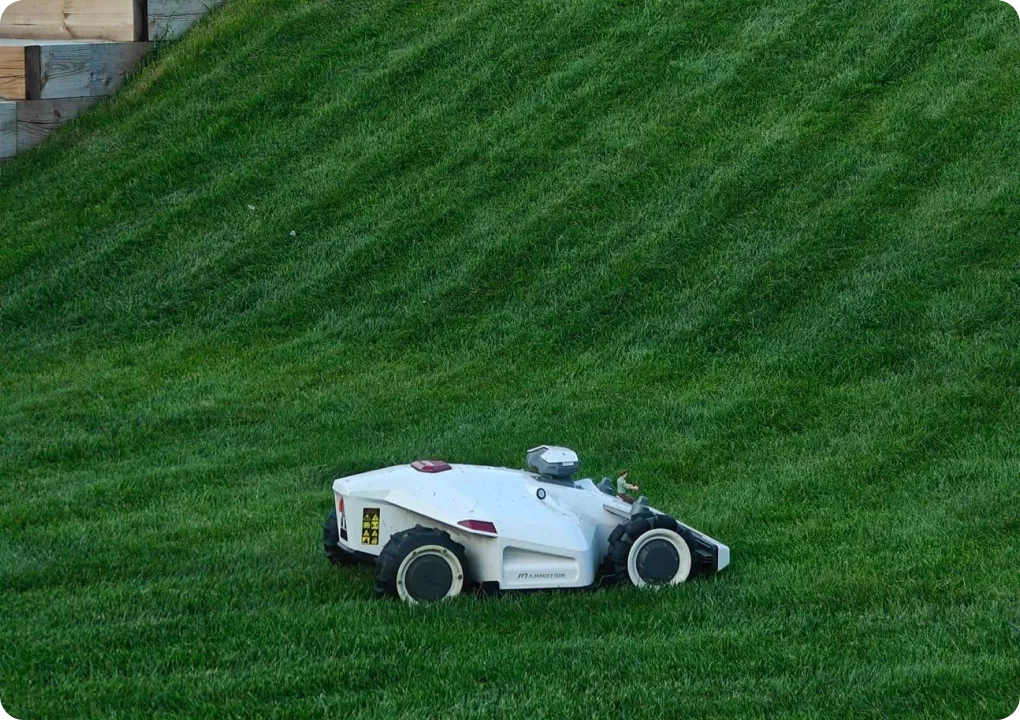
Modern robotic mowers achieve wire-free operation by combining artificial intelligence with advanced positioning and sensing technologies. Instead of following a buried wire, the mower builds a digital understanding of the lawn and navigates dynamically within it.
Several navigation approaches are now used, each with different strengths depending on lawn size, layout, and environmental conditions. (How does AI Vision work in wire-free robot lawn mowers?)
1. RTK-GPS + AI Vision
One of the most common wire-free solutions pairs Real-Time Kinematic (RTK) GPS with camera-based AI vision.
- RTK GPS improves standard satellite positioning by using correction data from a reference station, allowing the mower to locate itself with centimeter-level accuracy. This precise positioning helps define virtual boundaries and optimize mowing paths.
- AI vision systems use cameras and machine learning models to recognize obstacles, identify lawn edges, and interpret surface changes.
- Together, RTK and vision allow the mower to operate efficiently in open or moderately complex environments while avoiding common obstacles.
This setup is widely used in premium robotic mowers and offers a strong balance between accuracy, safety, and autonomy.

2. LiDAR + AI Vision
For more intricate landscapes, LiDAR (Light Detection and Ranging) adds another layer of precision. LiDAR systems emit laser pulses to measure distances, creating a detailed three-dimensional map of the surroundings in real time.
When combined with AI vision:
- LiDAR provides accurate spatial geometry
- Vision systems classify objects and detect movement
- The mower can navigate shaded areas, narrow passages, and irregular shapes more reliably
This approach performs particularly well in yards with dense tree cover, varied terrain, or limited satellite visibility.

3. Mammotion Tri-Fusion Navigation: RTK, LiDAR, and Vision Together
The most advanced robotic lawn mowers now integrate multiple navigation systems simultaneously. Mammotion Tri-fusion navigation combines RTK GPS, LiDAR, and AI vision into a single adaptive framework.
How Tri-Fusion Navigation Works
Sensor prioritization adjusts in real time depending on conditions
- RTK GPS handles open spaces and global positioning
- LiDAR manages complex geometry and cluttered areas
- Vision enhances obstacle recognition and contextual awareness
By blending these inputs, the mower maintains extremely high positional accuracy across diverse environments. This approach minimizes reliance on any single technology and delivers consistent performance even when conditions change.

Comparing Wire-Free Navigation Technologies
|
Navigation Approach |
Core Technologies |
Strengths |
Limitations |
Best Suited For |
|
Vision-based |
AI cameras |
Simple setup, strong object recognition |
Lower positional accuracy, light sensitivity |
Small to medium lawns |
|
RTK + Vision |
RTK GPS + AI cameras |
High precision, efficient coverage |
Requires good satellite reception |
Open or moderately complex lawns |
|
LiDAR + Vision |
LiDAR + AI cameras |
Excellent 3D mapping, reliable in shade |
Higher cost and power usage |
Dense or irregular lawns |
|
Mammotion Tri-Fusion |
RTK + LiDAR + Vision |
Maximum accuracy and adaptability |
Premium pricing |
Complex, multi-zone properties |
Practical Benefits of Wire-Free AI Robotic Lawn Mowers
1. Simplified Setup and Configuration
Without perimeter wires, installation is largely digital. Lawn boundaries, restricted areas, and multiple zones can be created or adjusted through a mobile app in minutes rather than hours.
2. More Intelligent Mowing Behaviour
AI navigation allows mowers to plan efficient routes, reduce overlap, and adapt to irregular lawn shapes. Over time, many systems refine their coverage patterns to improve consistency and reduce operating time.
3. Enhanced Safety and Obstacle Awareness
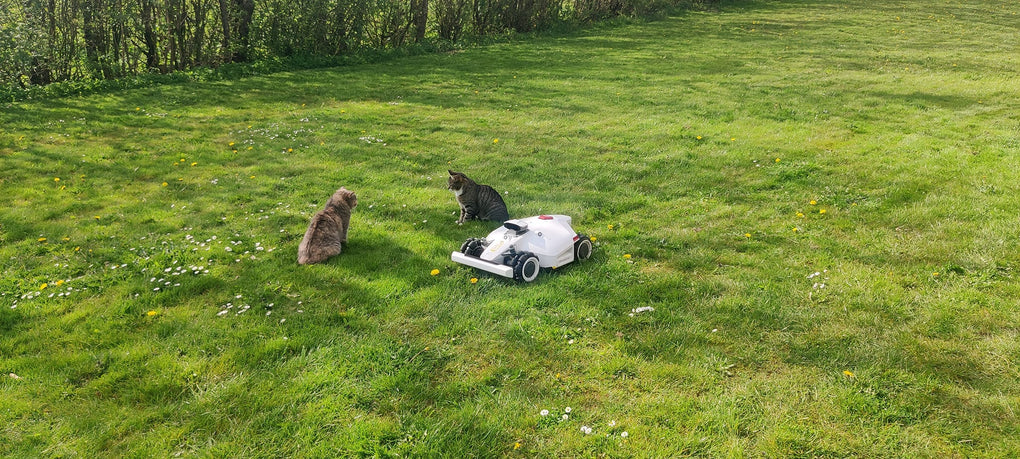
Advanced sensors enable the mower to detect pets, children, toys, and furniture before making contact. This reduces damage to both the mower and the surrounding landscape while improving overall safety.

4. Greater Flexibility for Evolving Landscapes
Seasonal changes, temporary obstacles, or landscaping updates can be handled through software adjustments instead of physical rewiring. This makes wire-free mowers especially suitable for modern, dynamic outdoor spaces.
5. Improved Energy Efficiency
By tracking where they have already mowed, AI-driven systems minimize unnecessary movement. This leads to better battery utilization, shorter mowing cycles, and lower overall energy consumption.
Limitations and Considerations of Wire-Free AI Robot Lawn Mowers
While wire-free robotic lawn mowers represent a major advancement in autonomous lawn care, they are not a one-size-fits-all solution. Like any emerging technology, AI-driven navigation systems still face certain limitations. That said, it’s important to note that ongoing improvements in hardware, software, and sensor fusion have already addressed many early shortcomings—and continue to push performance forward each year.
1. Higher Initial Investment
Wire-free robotic mowers rely on advanced components such as AI processors, high-resolution cameras, RTK GPS modules, and LiDAR sensors. These technologies significantly enhance precision and autonomy, but they also increase manufacturing costs. As a result, wire-free models typically require a higher upfront investment compared to traditional perimeter-wire mowers. However, as adoption grows and technology matures, prices are gradually becoming more accessible.
2. Environmental and Signal Dependence
Despite major progress, AI navigation systems still interact closely with their environment.
- Vision-based systems can be influenced by low light, heavy shadows, fog, or extreme weather.
- RTK GPS performance depends on satellite signal quality and may be affected by dense tree cover, tall structures, or challenging terrain.
- LiDAR performs well in most conditions but may experience reduced accuracy in heavy rain or with highly reflective surfaces.
To mitigate these issues, modern high-end models increasingly combine multiple navigation technologies, allowing one system to compensate when another is less reliable.
3. Software-Centric Operation
Unlike traditional wired mowers, wire-free systems rely heavily on software. Initial digital mapping, occasional recalibration, and firmware updates are part of the ownership experience. While mobile apps have become far more intuitive and user-friendly, some users may still face a learning curve—particularly those less comfortable with connected devices or smart home technology.
4. Increased Energy and Processing Demands
Advanced navigation requires continuous data processing from multiple sensors. LiDAR scanning, real-time vision analysis, and positioning calculations all consume more power than basic wired systems. This can lead to higher battery usage, especially on large or complex lawns. Manufacturers are actively improving battery efficiency and energy management, but power consumption remains an important consideration.
Selecting the right navigation approach ultimately depends on lawn size and complexity, budget expectations, and the user’s comfort level with smart technology. As AI navigation continues to evolve, many of today’s limitations are steadily becoming less significant—making wire-free robotic mowers an increasingly practical long-term solution.
Final Thoughts: The Future of Robotic Lawn Care
The transition from perimeter wires to AI-driven navigation represents a major milestone in robotic lawn care. What was once a rigid, installation-heavy system has evolved into a flexible, intelligent solution capable of adapting to real-world environments.
By combining technologies such as AI vision, RTK GPS, LiDAR, and advanced sensor fusion, wire-free robotic lawn mowers deliver greater precision, safety, and autonomy than ever before. For homeowners looking to simplify lawn maintenance while embracing smarter technology, AI navigation without perimeter wires is quickly becoming the new standard.
Did you like this article? Add us as a preferred source to find us more easily on Google.